AGPL License Explained: A Simple Guide for Developers and Businesses

There are many different licenses, and each one comes with its own rules about using, modifying, sharing, and distributing software. One license you may come across, especially when working with web applications and server-based software, is the AGPL license. AGPL stands for GNU Affero General Public License. It is a free and open source license based on the GNU GPL, but it includes an important additional requirement for software that users interact with over a network.
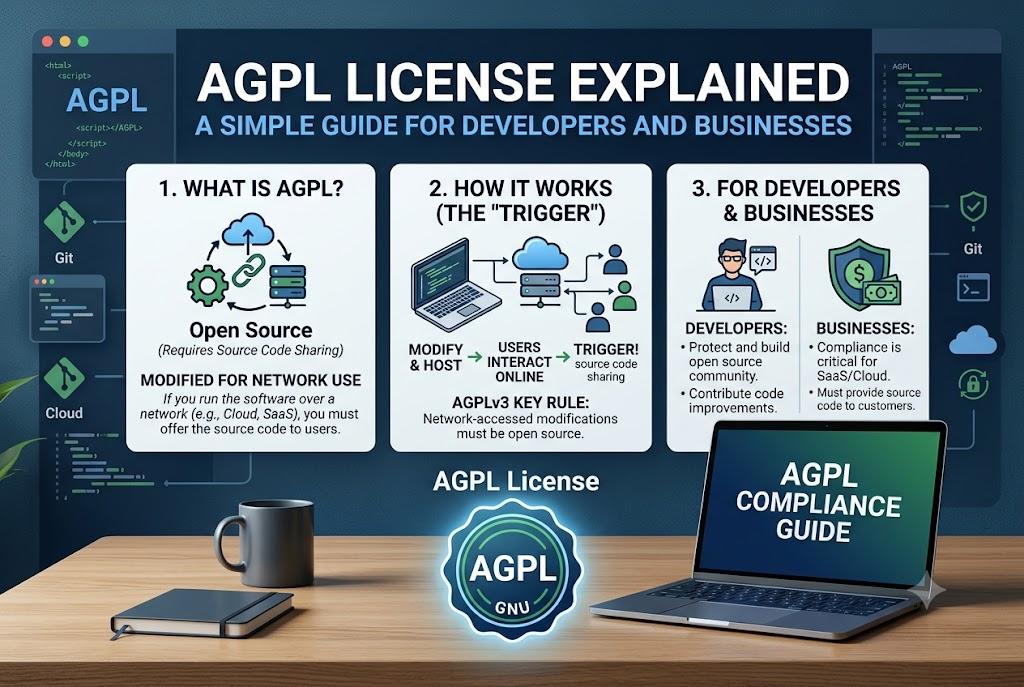
What Is the AGPL License?
The GNU Affero General Public License, commonly called AGPLv3, is a copyleft open source license.
Like other free software licenses, it gives users the freedom to use, study, modify, and share the software under the license terms. However, AGPL was specifically designed to address a situation that can happen with software running on servers.
With traditional GPL software, someone could modify the software and run that modified version on a server without distributing the modified source code to people who use the service. The AGPL adds a network interaction requirement intended to address this situation.
Why Was AGPL Created?
The way software is used has changed significantly. In the past, people commonly downloaded software and installed it directly on their computers. Today, many applications run on remote servers. Users simply open a browser or application and interact with the software over a network.
This creates an important question: What happens when someone modifies open source software but only provides access to it as an online service?
The AGPL was designed specifically to address this type of network-based use. Its purpose is to help ensure that users interacting remotely with a modified AGPL program can receive the corresponding source code under the license's conditions.
How Does AGPL Work?
The easiest way to understand AGPL is to think about the idea of sharing modifications. Imagine a developer takes an AGPL-licensed application and makes significant changes to it. They then run that modified version on a web server and allow people to use it through the internet.
Under AGPLv3, the modified program must prominently offer those remote users an opportunity to receive the corresponding source code, when the network-interaction provision applies.
AGPL Is a Copyleft License
To understand AGPL, it's helpful to understand the word copyleft. Copyleft doesn't mean that copyright is removed. Instead, it uses copyright law to preserve users' freedoms under the license.
When you distribute a covered modified version, the license places conditions on how that modified work can be distributed. AGPLv3 requires covered modified versions to remain under AGPLv3 when conveyed as a whole, subject to the license's terms and exceptions.
This helps ensure that software and its modifications remain available under the same open source framework.
Does AGPL Mean You Cannot Use the Software Commercially?
No.
AGPL software can be used commercially. The license does not simply say that you cannot make money from AGPL software.
The important part is understanding and following the license obligations that apply to your particular use. For example, if you're building a business around AGPL software, you need to consider how you're modifying, combining, distributing, or providing access to that software. Because software licensing can become complicated, organizations with significant commercial or legal concerns should get advice from a qualified licensing professional.
Can You Modify AGPL Software?
Yes.
One of the benefits of open source software is the ability to study and modify the code according to the license.
However, modifying AGPL software doesn't mean the license requirements disappear. If you distribute or convey a modified covered version, or if the network interaction provision applies, you may have source-code and licensing obligations. This is why developers should read the actual license terms before building a product around AGPL software.
What Happens When AGPL Software Runs on a Server?
This is where AGPL becomes especially interesting. Suppose an organization takes an AGPL application, changes the code, and runs it as a web application.
Because the program is designed to accept requests and respond to users over a network, the AGPL's remote-network interaction provision may apply. The license requires the modified version to offer those users an opportunity to receive the corresponding source code. For a web application, this could be implemented through a clearly visible source-code link or another method that meets the license requirements.
Does AGPL Make All Your Software Open Source?
Not necessarily. This is one of the areas where people often oversimplify open source licensing. Whether other software must be licensed under AGPL depends on how the software is combined, what components are covered, and the specific license terms that apply.
For example, simply running unrelated proprietary software on the same server does not automatically make that software AGPL. The details of how programs interact or are combined matter.
For this reason, developers should not assume that "using one AGPL component means everything must become AGPL." The actual licensing relationship needs to be evaluated carefully.
What Are the Benefits of AGPL?
AGPL can be useful for projects where developers want improvements to remain available to the community, particularly when the software is commonly operated as a network service.
Some potential benefits include:
- Encouraging transparency
- Keeping modifications available under the license
- Supporting open source collaboration
- Giving network users access to corresponding source under the license's requirements
- Reducing the possibility of modified versions being offered only as closed online services
The right license depends on the goals of the project. AGPL is not automatically the best choice for every application.
Why AGPL Matters for Open Source Healthcare Software
For community healthcare organizations, choosing an open source EHR can also be a long-term technology decision. Beyond the features of the software, organizations should understand how the licensing model affects customization, development, and future use. A clear understanding of the license can help teams make informed decisions while keeping the benefits of open source technology.
AGPL can be particularly relevant for healthcare software that is delivered through networks. Healthcare organizations increasingly use web-based applications and connected systems, so understanding the license behind the software is important when evaluating an open-source solution. For a broader look at why open-source EHRs can be valuable for healthcare organizations, you can also explore why community clinics need open-source EHRs.
AGPL Does Not Mean "No Rules"
One common misunderstanding is that open source software has no restrictions. That's not true.
Open source licenses provide freedoms, but those freedoms come with conditions. AGPLv3, for example, has specific requirements covering copyright notices, licensing, source code, modifications, and remote network interaction. The key is not to think of AGPL as either "completely free" or "highly restrictive."
Final Thoughts
For developers, the most important thing is to understand the license before modifying, distributing, combining, or providing access to AGPL software. AGPL can be a strong choice for projects that want to encourage openness and ensure that certain modifications remain available to users. For businesses and healthcare organizations, understanding the license can help avoid surprises later. Open source gives organizations valuable freedom, but that freedom works best when everyone understands the responsibilities that come with it.
Have questions about running an AGPL-licensed EHR in your organization? Schedule an appointment with our team to talk through deployment, customization, and licensing considerations.