What Is Click Fatigue in Healthcare?

A doctor may need to open several screens just to find a patient's medication list. A nurse may have to move through multiple menus to document a simple update. A staff member may need to enter the same information in different places. But when those clicks happen hundreds of times throughout the day, they can become a real source of frustration. This is often referred to as click fatigue in healthcare.
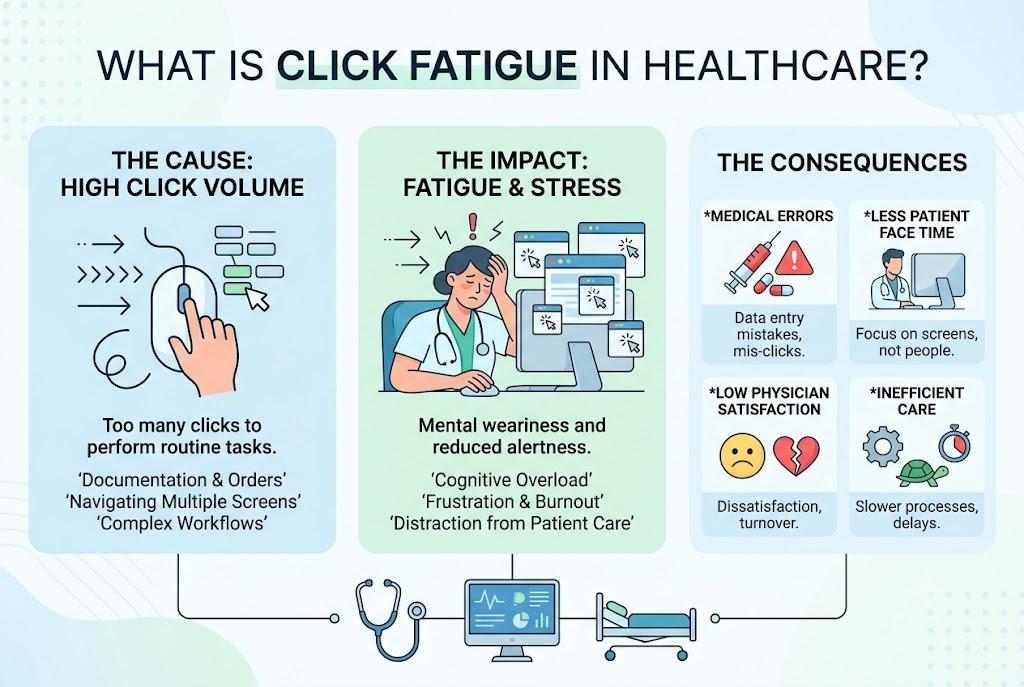
What Is Click Fatigue?
Click fatigue is the frustration and mental effort that can come from repeatedly clicking through complicated software interfaces to complete everyday tasks. In healthcare, this often happens when an EHR requires users to move through too many screens, menus, tabs, or pop-ups. The issue isn't simply the number of clicks. It's what those clicks represent.
Every unnecessary step can interrupt a clinician's workflow, take attention away from the patient, and make simple tasks feel more complicated than they should be.
Why Does Click Fatigue Matter?
Healthcare workers already have demanding jobs. Adding unnecessary technology-related work can make their day even more difficult. Imagine a physician trying to speak with a patient while also searching through several screens to find recent test results. The doctor has to divide attention between the patient and the computer.
Over time, this can become frustrating.
A well-designed EHR should support the healthcare professional's workflow rather than constantly interrupting it.
How Too Many Clicks Affect Clinicians
Click fatigue can affect more than just convenience.
When clinicians repeatedly navigate complicated systems, they may experience:
- More interruptions during patient visits
- Slower documentation
- Greater mental workload
- More time spent navigating software
- Frustration with the EHR
- Less time for direct patient interaction
Not every extra click is a problem. Some actions are necessary for accuracy, privacy, and documentation.
The goal is to identify the clicks that don't add meaningful value.
The Connection Between Clicks and Patient Interaction
One of the biggest concerns with excessive EHR interaction is that it can affect the patient experience. A patient wants to feel that their doctor is listening. But if the physician is constantly looking at the screen, searching for information, or clicking through different menus, the conversation can feel less personal.
This doesn't mean clinicians should stop using technology during appointments. Instead, healthcare software should make it easier for them to use the system while staying engaged with the patient. That means information should be easy to find, important actions should be simple, and unnecessary navigation should be reduced.
Why EHR Design Makes a Difference
Two EHR systems can perform similar tasks but provide very different user experiences. One may require users to open multiple menus and screens. Another may present the most important information in one place. Good EHR design focuses on how people actually work.
For example, a clinician may need to see:
Patient history + Medications + Recent results + Vitals
If this information is available in one clear view, the clinician doesn't need to search through several different areas of the system. That small design choice can make everyday work much easier.
Click Fatigue Is Not Just About Speed
It might seem like reducing clicks is simply about helping clinicians work faster. But there is more to it than speed. Reducing unnecessary clicks can also make software easier to understand and less mentally demanding.
When users don't have to constantly remember where information is located or which menu they need next, they can focus more attention on the actual task. In healthcare, that task is often caring for the patient.
How Can Healthcare Organizations Reduce Click Fatigue?
The first step is to understand where unnecessary clicks are happening.
Healthcare organizations can observe common workflows and ask simple questions:
- How many steps does it take to complete a routine task?
- Do users have to enter the same information more than once?
- Is important information easy to find?
- Are commonly used actions buried inside menus?
- Do clinicians have to switch between multiple screens?
- Which parts of the EHR frustrate users the most?
The answers can reveal opportunities for improvement.
Use Unified Views for Important Information
One way to reduce unnecessary navigation is to bring related information together. Instead of forcing a clinician to open separate screens for medications, history, and recent results, a unified view can make important information available at a glance.
This can help clinicians understand the patient's situation without constantly moving between different parts of the EHR. It also makes the technology feel more like a helpful workspace and less like a collection of separate menus.
Voice and Automation Can Help
Typing and clicking aren't the only ways clinicians can interact with healthcare software. Voice-to-text and other automation tools can reduce some of the manual work involved in documentation.
For example, a clinician may be able to dictate information instead of typing every detail manually. Automation can also help with repetitive tasks such as populating information, organizing records, or suggesting commonly used options.
Designing Around the Clinician's Workflow
Technology should fit the way healthcare professionals work. If a system forces clinicians to change their natural workflow just to use the software, frustration can increase. A better approach is to understand the real clinical process first and then design the technology around it.
This is one reason minimizing unnecessary clicks in healthcare is important. Ciyex describes a minimal-click approach that brings important patient information together, simplifies navigation, and uses tools such as voice documentation to help clinicians spend less time interacting with the EHR and more time engaging with patients.
Click Fatigue and Physician Burnout
Technology is only one factor that can contribute to physician burnout, and click fatigue should not be treated as the sole cause. However, unnecessary administrative work and difficult software workflows can add to the daily burden clinicians experience.
When physicians spend less time fighting with technology, they may have more time for documentation that matters, patient conversations, and clinical decision-making. Improving the EHR experience is therefore one part of creating a healthier clinical workflow.
What Should Healthcare Organizations Look for in an EHR?
When evaluating an EHR, organizations should look beyond the list of features.
The user experience matters too.
Consider questions such as:
- Is important information easy to find?
- How many steps do common tasks require?
- Can workflows be customized?
- Does the system reduce duplicate data entry?
- Can clinicians use voice or other efficient documentation tools?
- Does the interface support patient interaction?
- Can staff learn the system without extensive training?
An EHR can have hundreds of features, but if everyday tasks are unnecessarily difficult, those features may not provide much practical value.
Conclusion
Click fatigue in healthcare may sound like a small usability issue, but repeated unnecessary interactions with technology can add up throughout a clinician's day. The solution isn't simply to remove as many clicks as possible. It's to design healthcare software around real workflows, make important information easier to find, simplify common tasks, and reduce repetitive work.
Want to see how a minimal-click EHR experience could work for your team? Schedule an appointment with our team to explore how Ciyex can help simplify everyday clinical workflows.