Audit Logs in Healthcare Software: What They Are and Why They Matter

Healthcare software handles some of the most sensitive information people have. Patient records can include medical histories, diagnoses, medications, test results, insurance information, and other private details.
But protecting this information isn't only about preventing unauthorized access. Healthcare organizations also need to understand what happened to the data, who accessed it, and when the activity occurred.
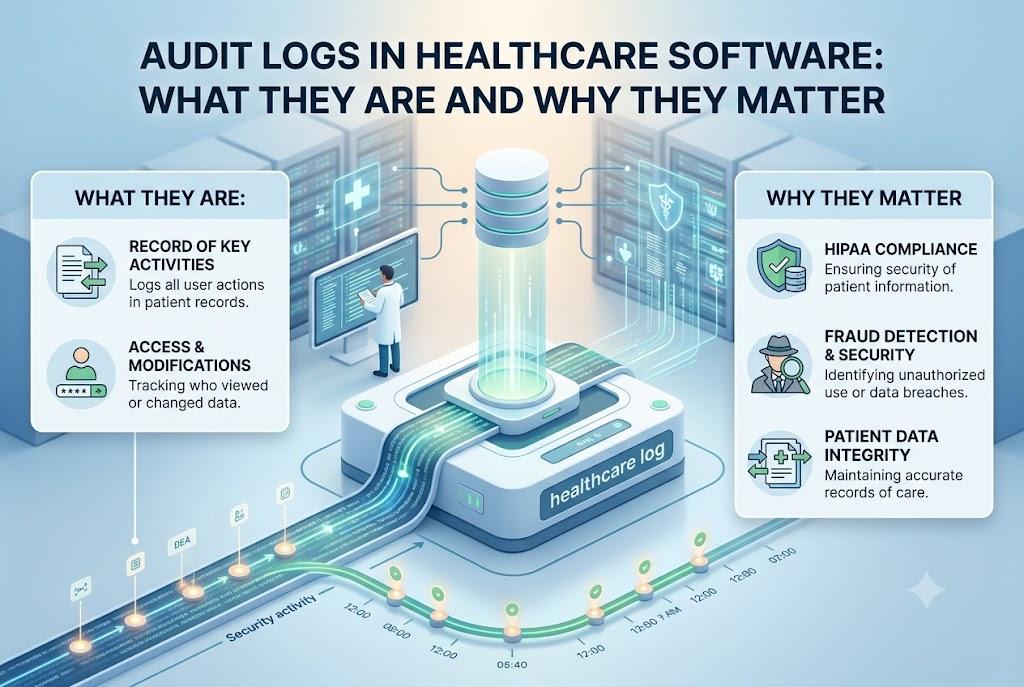
What Is an Audit Log?
An audit log is a record of activity performed within a software system.
Imagine a patient record is opened by a healthcare worker. The system can record that the record was accessed, identify the user, and record the time of the activity.
If information is later changed, the system can record that action as well.
A healthcare application may create audit records for activities such as:
- Logging in and logging out
- Viewing patient records
- Creating or updating information
- Deleting or modifying records
- Changing user permissions
- Updating system settings
- Attempting to access restricted information
The exact events that should be recorded depend on the system, its risks, and applicable policies and requirements. Under the HIPAA Security Rule, organizations handling electronic protected health information (ePHI) are required to implement audit controls that record and examine activity in relevant information systems.
Why Are Audit Logs Important in Healthcare?
Healthcare systems are used by many different people throughout the day. Doctors, nurses, administrators, billing teams, support staff, and other authorized users may interact with patient information. Without an activity record, it can be difficult to understand what happened when something goes wrong.
For example, imagine that information in a patient's record was unexpectedly changed. An audit trail can help an organization investigate the event by showing which account performed the action and when it happened. This doesn't prevent every security problem, but it gives organizations visibility into activity that would otherwise be difficult to trace.
Audit Logs Help Protect Patient Information
Patient privacy is a major responsibility for healthcare organizations. An audit trail can help organizations monitor access to sensitive information and identify unusual activity. For example, if someone accesses records they normally would not need for their job, the activity can be investigated.
This makes audit logging an important part of a broader healthcare security strategy. It is important to remember, however, that an audit log is not a replacement for access controls, authentication, encryption, or other security measures. It works alongside those controls.
What Information Should an Audit Log Record?
There isn't one universal list that applies identically to every healthcare application. Organizations should determine what activity needs to be tracked based on their systems, risks, and requirements. HHS guidance specifically describes determining which systems and activities should be audited and reviewing whether those records are actually generated and examined.
Depending on the application, useful audit information can include:
- Who performed the action
- What action was performed
- When it happened
- Which record or resource was involved
- Whether the action succeeded or failed
- Where the activity originated, when relevant
The goal is to create enough context to understand an event later.
Audit Logs and EHRs
Electronic Health Records are at the center of many healthcare workflows, which makes audit logging especially important. A doctor may view a patient's history, a nurse may update clinical information, and an administrator may change account permissions. These activities can affect sensitive information and should be traceable according to the organization's policies and technical design.
A good EHR audit trail should make it easier to understand the history of important actions without making the system difficult to use. For example, if a patient's information changes, the organization should be able to determine what happened and investigate the change when necessary.
Audit Logs Can Help Investigate Suspicious Activity
Imagine a healthcare organization notices that a patient record was accessed unexpectedly. Instead of relying on assumptions, the security or compliance team can look at the audit trail and investigate the activity.
They may be able to determine:
- Which account accessed the record
- When the access occurred
- What action was performed
- Whether other related activity occurred
This information can help the organization understand what happened and decide what action may be necessary.
Audit Trails Can Support Data Integrity
Healthcare records can change over time. New information may be added, existing information may be corrected, and certain records may need to be updated. An audit trail can help provide visibility into these changes.
Rather than simply showing the current state of a record, a well-designed audit system can provide a history of relevant actions. This can make it easier to understand how information changed over time. That visibility can be valuable when reviewing an unexpected change or investigating a discrepancy.
Audit Logs and HIPAA
For organizations subject to HIPAA, audit controls are an important part of the Security Rule. The HIPAA Security Rule's audit-controls provision, 45 CFR §164.312(b), calls for hardware, software, and/or procedural mechanisms that record and examine activity in information systems containing or using ePHI. HHS guidance also emphasizes that organizations should have processes for reviewing information-system activity records.
However, organizations shouldn't think of HIPAA audit logging as simply checking a box. The actual design of audit logging should be based on the organization's systems, risks, workflows, and compliance responsibilities.
Audit Logs Should Not Create Another Problem
Healthcare systems can generate a large amount of activity. If every technical event is recorded without considering its usefulness, organizations can end up with enormous amounts of information that nobody reviews.
More logging isn't automatically better.
The goal should be to capture meaningful activity and make it possible to find important events when they matter. Healthcare organizations should also consider how audit information will be stored, protected, reviewed, and managed over time. A well-designed audit system should provide visibility without becoming impossible to manage.
Audit Logs and User Privacy
Audit logging itself involves sensitive information. An audit record may reveal which patient record was accessed, which user performed an action, and when the activity happened. That means audit logs also need appropriate protection.
Auditability is also closely connected to transparency. Healthcare organizations need to understand not only who accessed information, but also how their software handles and protects that information. Open-source software can provide greater visibility into the underlying system because its code can be reviewed and examined. This makes open-source security an interesting part of the broader conversation around protecting sensitive healthcare data.
The Role of Audit Logs in Modern Healthcare Software
Healthcare software is becoming more connected. EHRs communicate with laboratories, pharmacies, patient portals, billing systems, APIs, and other healthcare applications. As systems become more interconnected, understanding activity across those systems becomes increasingly important.
Modern healthcare software should therefore think about auditability as part of the architecture—not something that is added at the very end. When audit capabilities are built into the system from the beginning, organizations can have better visibility into how information moves and how users interact with the platform.
Audit Logs Are Part of a Bigger Security Strategy
Audit logs are important, but they are only one part of healthcare security.
A secure healthcare application may also need:
- Strong authentication
- Role-based access controls
- Encryption
- Secure APIs
- Regular security testing
- Backup and recovery processes
- Vulnerability management
- Monitoring and incident response
These controls work together.
An audit log can tell you that something happened, but other security controls help prevent unauthorized activity from happening in the first place.
Conclusion
Audit logs in healthcare software provide something extremely valuable: visibility.
They help healthcare organizations understand who accessed information, what actions were performed, and when those actions occurred. They can support security investigations, data integrity, compliance processes, and better oversight of sensitive healthcare systems. But effective audit logging is about more than simply recording events. Healthcare organizations need to decide what activity should be captured, protect the logs themselves, and establish processes for reviewing the information. As healthcare technology becomes more connected, auditability will continue to be an important part of building trustworthy software.
Want to review how your EHR handles audit trails and access visibility? Schedule an appointment with our team to talk through your security and compliance requirements.