How FHIR APIs Connect Healthcare Systems

Healthcare is becoming more connected every day. Hospitals, clinics, laboratories, pharmacies, and healthcare applications all create and manage important patient information. However, when these systems cannot communicate with each other, healthcare providers may struggle to access complete and accurate patient data.
This is where FHIR APIs play an important role.
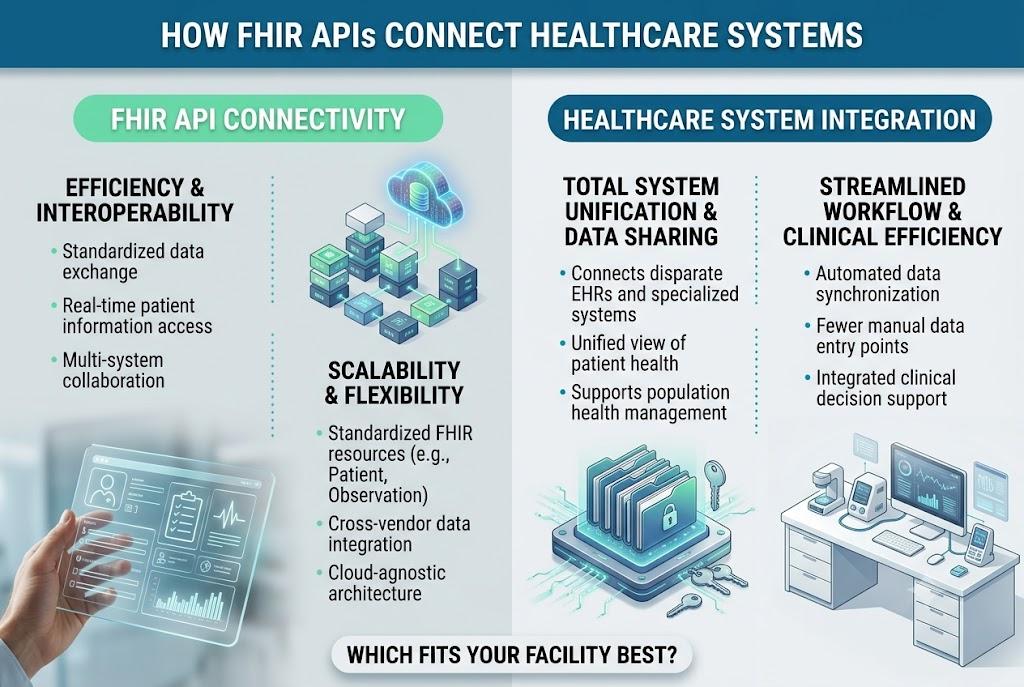
FHIR APIs help different healthcare systems exchange information securely and efficiently. They allow applications to communicate using a common standard, making it easier for healthcare organizations to connect systems, improve workflows, and provide better patient care.
What Are FHIR APIs?
FHIR stands for Fast Healthcare Interoperability Resources. It is a modern healthcare data exchange standard created to help different healthcare systems share information more easily.
An API (Application Programming Interface) allows different software applications to communicate with each other.
Together, FHIR APIs provide a way for healthcare applications to securely exchange patient information in a structured format.
For example, a hospital EHR system can use FHIR APIs to share information with a laboratory system, pharmacy application, or patient health app without requiring manual data entry.
Why Healthcare Systems Need FHIR APIs
Healthcare organizations often use multiple systems to manage patient information. A clinic may have an EHR system, a laboratory may have its own software, and a pharmacy may use another application.
Without interoperability, these systems operate separately. This can create problems such as:
- Difficulty accessing complete patient records
- Repeated data entry
- Delayed communication between providers
- Increased chances of errors
- Poor coordination of care
FHIR APIs help solve these challenges by creating a common language that allows different healthcare technologies to work together.
How FHIR APIs Improve Healthcare Data Exchange
Traditional healthcare systems often depended on older methods of sharing information. These approaches could be complex, difficult to maintain, and limited in flexibility.
FHIR APIs use modern web technologies to make healthcare data exchange simpler.
For example, when a patient visits a specialist, the specialist can access relevant information from the patient's previous healthcare provider through connected systems. This helps providers understand the patient's history and make better decisions.
Instead of moving information manually, systems can communicate automatically.
The Role of FHIR Resources
FHIR organizes healthcare information into smaller, reusable components called resources.
These resources represent different types of healthcare data, such as:
- Patient information
- Medical conditions
- Medications
- Lab results
- Appointments
- Clinical observations
Because information is organized in a consistent way, different healthcare applications can understand and use the data more effectively.
This makes it easier for healthcare organizations to build connected digital health solutions.
FHIR APIs and EHR Interoperability
Electronic Health Records (EHRs) are at the center of modern healthcare. However, an EHR becomes more valuable when it can communicate with other systems.
FHIR APIs help EHR platforms exchange information with external applications, including:
- Health information exchanges
- Patient portals
- Telehealth platforms
- Medical devices
- Mobile healthcare applications
This creates a more connected healthcare environment where information can move securely between different points of care.
Benefits of Using FHIR APIs in Healthcare
Better Patient Care
When healthcare providers have access to complete and updated patient information, they can make more informed decisions. FHIR APIs help ensure that important health data is available when and where it is needed.
Improved Care Coordination
Many patients receive care from multiple providers. FHIR APIs allow doctors, specialists, and healthcare organizations to work with the same information. This improves communication and creates a smoother patient experience.
Reduced Manual Work
Healthcare staff often spend valuable time transferring information between systems. FHIR APIs can automate many data exchange processes, reducing administrative work and allowing teams to focus more on patient care.
Faster Innovation
FHIR APIs make it easier for developers and healthcare organizations to create new healthcare applications. New tools can connect with existing systems without requiring organizations to completely replace their current technology.
FHIR APIs and Patient Engagement
Modern patients want more control over their health information.
FHIR APIs help make this possible by allowing patients to securely access and share their healthcare data through approved applications.
For example, a patient can use a health application to view medical records, track health information, or share important data with healthcare providers.
This creates a more transparent and collaborative healthcare experience.
Security and Privacy Considerations
Healthcare information is highly sensitive, so security is a major priority when using FHIR APIs.
Healthcare organizations need strong security practices, including:
- Authentication and authorization controls
- Data encryption
- Access monitoring
- Compliance with healthcare privacy requirements
FHIR provides a framework for data exchange, but organizations must implement proper security measures to protect patient information.
While FHIR APIs make healthcare data exchange easier, security and compliance remain essential when handling sensitive patient information. Healthcare organizations must ensure that connected systems follow proper privacy practices and protect patient data during every exchange.
Understanding how FHIR works alongside healthcare regulations such as HIPAA is important for organizations building reliable digital health systems. Learn more in our detailed guide: HIPAA & FHIR: How Ciyex EHR Ensures Global Compliance Standards.
Why FHIR APIs Matter for the Future of Healthcare
Healthcare is moving toward a more connected digital ecosystem. As more organizations adopt digital health solutions, the ability to share information securely will become increasingly important.
FHIR APIs provide the foundation for this connected future by helping healthcare systems communicate more effectively.
Open and interoperable solutions, including an open-source EHR platform, can make it easier for healthcare organizations to adopt modern standards like FHIR. These platforms provide flexibility while supporting better integration with other healthcare technologies.
Ciyex Workspace follows this approach by using a FHIR R4-native architecture that helps healthcare organizations create connected workflows and exchange health information more efficiently.
Conclusion
FHIR APIs are changing the way healthcare systems communicate. By creating a common standard for healthcare data exchange, they help providers access important information, improve collaboration, and deliver better patient care.
As healthcare continues to become more digital, interoperability will be essential for building connected and efficient healthcare systems. Organizations that adopt FHIR-enabled solutions can create more flexible workflows and prepare for future healthcare innovations.
Ciyex Workspace helps healthcare organizations move toward this connected future with an open-source EHR platform built around interoperability and FHIR R4. By supporting secure data exchange and flexible integrations, Ciyex helps providers create a more connected healthcare experience.
Ready to improve healthcare interoperability and build a future-ready technology environment? Schedule an appointment with our team to explore how a flexible, FHIR-enabled EHR solution can support your goals.