FHIR vs HL7: What's the Difference?

Healthcare organizations use many different software systems every day. Hospitals, clinics, laboratories, pharmacies, and insurance providers all need to exchange patient information quickly and securely. But if these systems don't "speak the same language," sharing data becomes difficult.
This is where HL7 and FHIR come into the picture. Both are healthcare standards that help different systems communicate with each other, but they work in very different ways.
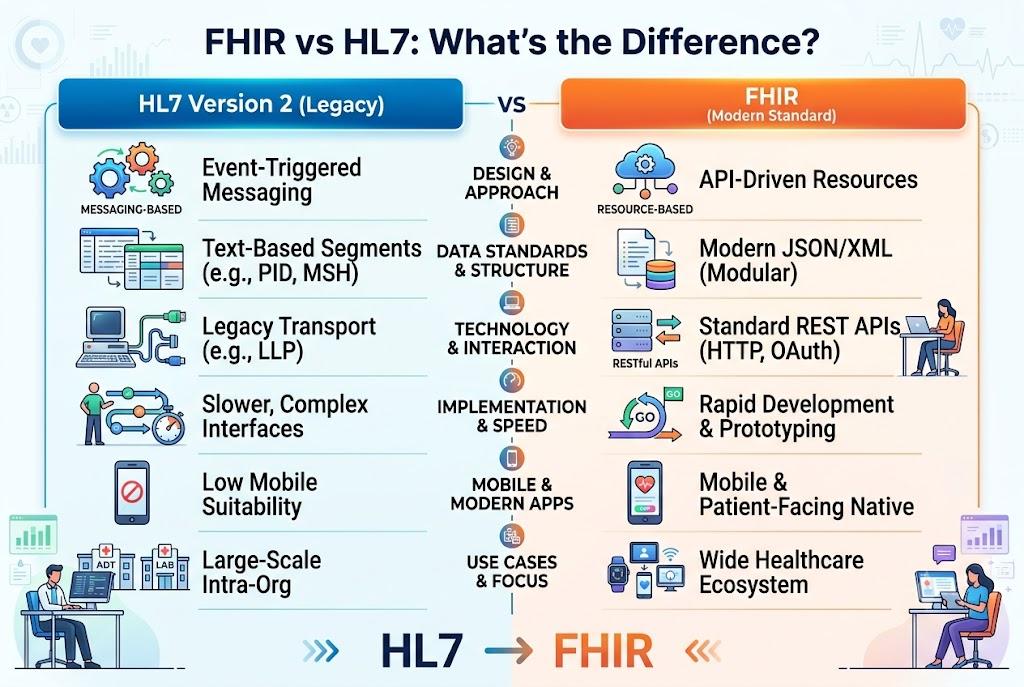
What Is HL7?
HL7, which stands for Health Level Seven, is a set of standards created to help healthcare systems exchange information.
For many years, HL7 has been widely used across hospitals and healthcare organizations. It allows systems like Electronic Health Records (EHRs), laboratory software, pharmacy systems, and billing platforms to share important patient information.
However, many older HL7 implementations were built before cloud technology, mobile apps, and modern APIs became common. As healthcare technology evolved, organizations needed a more flexible way to exchange data.
What Is FHIR?
FHIR (Fast Healthcare Interoperability Resources) is the newest standard developed by HL7. It was designed to make healthcare data sharing simpler, faster, and more compatible with modern web technologies.
Instead of using complex messaging formats, FHIR uses REST APIs, making it easier for different healthcare applications to connect and exchange information.
Because of its flexibility, FHIR is becoming the preferred standard for modern healthcare software, including cloud-based EHR platforms, patient portals, mobile applications, and telehealth solutions.
Why Was FHIR Introduced?
Healthcare has changed significantly over the last decade. Providers now use cloud applications, mobile devices, wearable health technology, and remote patient monitoring systems.
Older healthcare standards still work, but they were not built for today's connected environment. FHIR was introduced to make healthcare interoperability simpler, allowing developers to build applications faster while helping healthcare organizations exchange patient data more efficiently.
FHIR vs HL7: The Main Differences
Although both standards help systems communicate, they take very different approaches.
1. Technology
Traditional HL7 standards rely on older messaging formats that can be difficult to implement and maintain. FHIR uses modern web technologies, making it easier for developers to build applications that connect with healthcare systems.
2. Ease of Integration
Connecting new software to a legacy HL7 system often requires custom development and significant testing. FHIR makes integration much simpler by using APIs that many developers are already familiar with, reducing development time and making it easier to add new healthcare applications.
3. Data Sharing
HL7 messages often contain large amounts of information, even when only a small piece of data is needed. FHIR allows applications to request only the information they need — for example, a mobile app can retrieve a patient's allergies without downloading the entire medical record.
4. Mobile and Cloud Support
Modern healthcare increasingly depends on cloud services and mobile devices. FHIR was designed with these technologies in mind, making it an excellent choice for telemedicine platforms, patient portals, and mobile healthcare applications. Older HL7 standards were created before these technologies became widely used, so supporting them often requires additional work.
5. Flexibility
Healthcare organizations continue to adopt new technologies every year. FHIR's modular design allows developers to build new features without redesigning the entire system, making it easier to adapt as healthcare needs change.
A Simple Comparison
| Feature | HL7 | FHIR |
|---|---|---|
| First Released | Earlier healthcare standard | Modern healthcare standard |
| Technology | Traditional messaging | REST APIs and web technologies |
| Integration | More complex | Easier and faster |
| Cloud Support | Limited | Excellent |
| Mobile Friendly | Limited | Yes |
| Flexibility | Lower | Higher |
| Best For | Legacy healthcare systems | Modern digital healthcare |
Is HL7 Still Used?
Yes. Many hospitals and healthcare organizations still rely on HL7 because their existing systems were built around it. Replacing healthcare software takes time, so HL7 will continue to be used for many years. In fact, many organizations use both HL7 and FHIR together while gradually modernizing their technology.
Why More Organizations Are Choosing FHIR
Healthcare providers want systems that are easier to connect, maintain, and expand. FHIR supports these goals by making it simpler to:
- Share patient records securely
- Connect healthcare applications
- Build patient portals
- Support telehealth services
- Improve interoperability across organizations
As healthcare continues to become more digital, FHIR is helping organizations build systems that are ready for the future.
Conclusion
Both HL7 and FHIR play an important role in healthcare data exchange. HL7 has supported hospitals and healthcare providers for decades, while FHIR builds on that foundation using modern technologies that make integration faster and more flexible.
At Ciyex, we believe healthcare technology should be open, connected, and built for the future. That's why our open-source, FHIR-native EHR platform is designed to support seamless interoperability, modern APIs, and scalable healthcare solutions — whether you're modernizing an existing system or building a new digital health platform.
Looking to modernize your healthcare technology with FHIR? Schedule an appointment with our experts to learn how Ciyex can help you build a connected, interoperable, and future-ready healthcare platform that grows with your organization.