Streamlining Administrative Tasks in Healthcare: A Practical Guide

Healthcare professionals have a lot on their plates. Their main responsibility is taking care of patients, but a large part of their day can also involve administrative work. Entering information, updating records, scheduling appointments, checking documents, preparing reports, responding to messages, and completing other routine tasks can take up valuable time.
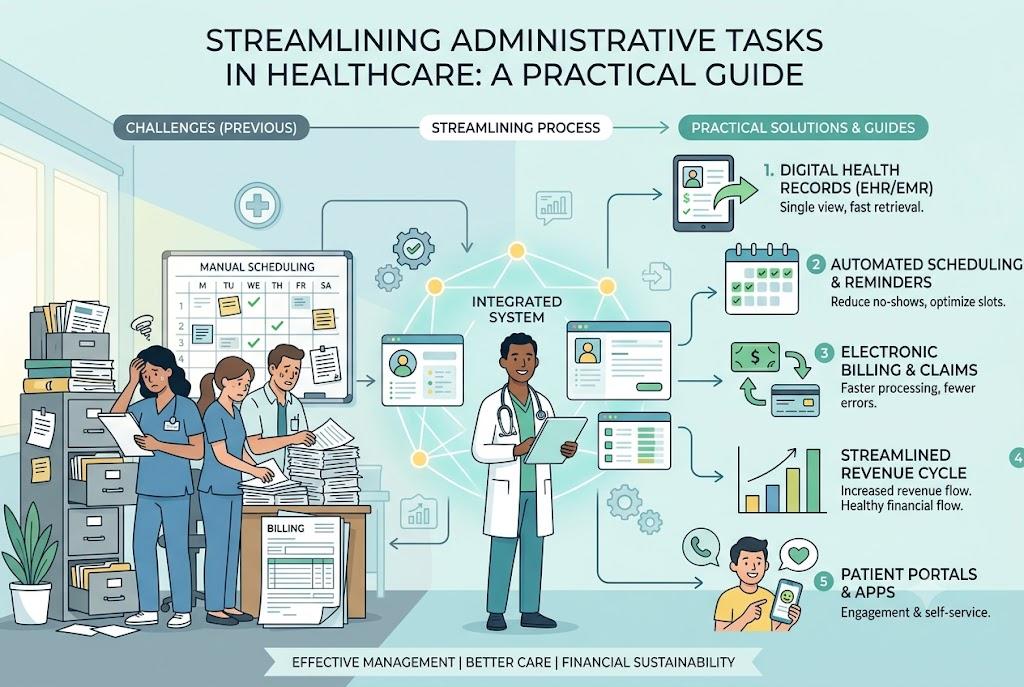
This is why streamlining administrative tasks has become an important goal for modern healthcare organizations. The idea is simple: make routine work easier, reduce unnecessary steps, and give healthcare teams more time to focus on patients.
What Are Administrative Tasks in Healthcare?
Administrative tasks are the activities that help a healthcare organization operate smoothly outside of direct patient care.
Some are handled by administrative staff, while others may be completed by nurses, physicians, or other healthcare professionals.
These tasks can include:
- Patient registration
- Appointment scheduling
- Insurance verification
- Data entry
- Documentation
- Record management
- Billing-related tasks
- Report preparation
- Communication and follow-ups
But when the same tasks are repeated throughout the day, the total amount of time can become significant.
Why Do Administrative Tasks Take So Much Time?
One reason is that many healthcare workflows involve several steps.
A staff member may need to enter the same information into different systems. A physician may have to search through multiple screens to find patient information. Someone may need to manually transfer laboratory results or prepare reports using information stored in different places.
The problem isn't always the amount of work itself. Sometimes, the workflow is simply more complicated than it needs to be. When technology adds unnecessary clicks, repeated data entry, or disconnected processes, even simple tasks can become time-consuming.
Streamlining Doesn't Mean Removing Important Work
There is an important difference between reducing administrative work and removing necessary administrative processes. Healthcare organizations still need accurate records, proper documentation, billing information, patient communication, and other essential processes. The goal is to remove unnecessary effort, not necessary work.
For example, if the same patient information has already been entered into the system, staff shouldn't have to manually enter that information again in several different places. A better workflow allows information to move where it is needed while maintaining appropriate security and access controls.
Reduce Repetitive Data Entry
Repeated data entry is one of the easiest areas to improve. Imagine a patient provides their basic information during registration. If staff then have to enter the same details into multiple systems, time is being spent on a task that could potentially be simplified. Well-designed healthcare software can help reduce this repetition by allowing information to flow between connected parts of the system.
Make Information Easier to Find
Administrative efficiency isn't only about entering information. Finding information matters too. Healthcare workers may need to look for patient histories, previous visits, test results, insurance details, or other information before completing a task. If that information is spread across different screens or systems, staff may spend more time searching than actually working.
A well-organized EHR can bring relevant information together so users don't have to constantly move between different parts of the system. This can make workflows faster and less frustrating.
Automation Can Handle Repetitive Tasks
Automation can be useful when a task follows the same pattern repeatedly. For example, software may be able to automatically populate certain fields, organize information, generate routine reports, or move information between connected workflows.
The idea isn't to automate everything.
Instead, organizations should identify tasks where automation can reduce repetitive manual work without compromising accuracy or oversight. Some useful areas for automation include:
- Automatically populating available information
- Generating routine reports
- Sending reminders
- Organizing patient information
- Updating workflow statuses
- Reducing duplicate data entry
Better Workflows Can Help Physicians Too
Administrative burden doesn't only affect front-office staff. Physicians also spend time documenting visits, reviewing records, navigating EHR screens, and completing other digital tasks. When an EHR requires too many clicks or makes information difficult to find, physicians may spend more time interacting with the software than they need to. A more streamlined approach can make the system fit the way healthcare professionals actually work.
Ciyex explores this idea in streamlined healthcare workflows, including reducing unnecessary clicks, customizing workflows, and using automation to make clinical work less dependent on repetitive data entry.
Connected Systems Can Reduce Administrative Work
Healthcare organizations rarely use just one system. They may use an EHR, laboratory system, pharmacy system, billing platform, scheduling software, patient portal, and other tools. When these systems cannot communicate effectively, staff may have to manually move information from one place to another.
Healthcare information technology plays an important role in connecting different parts of a healthcare organization. When EHRs, scheduling systems, billing platforms, laboratories, and patient portals can work together, staff don't have to spend as much time moving information manually between systems. The right technology can make information easier to access, reduce repetitive tasks, and support smoother workflows without adding unnecessary complexity.
How to Identify Administrative Bottlenecks
Before changing a workflow, it helps to understand where the biggest problems are.
Healthcare organizations can observe everyday processes and look for tasks that repeatedly cause delays.
For example, ask:
- Which tasks require the most manual steps?
- Where do employees frequently have to switch between systems?
- Which processes create the most follow-up work?
- Where do errors or delays happen repeatedly?
These questions can help identify the areas where streamlining could have the biggest impact.
Start With Small Improvements
Streamlining doesn't always require a complete technology overhaul. Sometimes, a small workflow improvement can make a noticeable difference. For example, reorganizing a commonly used screen, removing unnecessary steps, automating a repetitive report, or connecting two systems can save time every day. The key is to focus on real problems instead of trying to change everything at once. Small improvements can also make it easier for staff to adapt to new workflows.
The Human Side of Administrative Efficiency
Technology is only one part of the solution. Healthcare organizations should also listen to the people who actually use the workflows every day. A process may look efficient on paper but feel completely different to the person using it.
Doctors, nurses, receptionists, billing teams, and administrators can often identify problems that aren't obvious from a technical perspective. Their feedback can help organizations design workflows that are not only faster but also easier to understand and use.
Conclusion
Administrative work will always be part of healthcare. The goal isn't to eliminate it completely. The goal is to make it simpler, more connected, and less repetitive. By reducing duplicate data entry, improving information access, automating routine tasks, and connecting healthcare systems, organizations can create workflows that are easier for staff and clinicians to manage.
The best technology should not make healthcare teams learn more complicated processes. It should help them complete necessary work with fewer unnecessary steps.
Ready to simplify the administrative side of your practice? Schedule an appointment with our team to see how Ciyex can help connect your workflows and reduce repetitive work.