Cloud-Based vs Self-Hosted EHR: Which Is Better?

Healthcare organizations today have more choices than ever when selecting an Electronic Health Record (EHR) system. But choosing the right EHR is not only about features, usability, or price. One important decision is where the EHR will be hosted.
Should your organization use a cloud-based EHR, or would a self-hosted EHR give you more control?
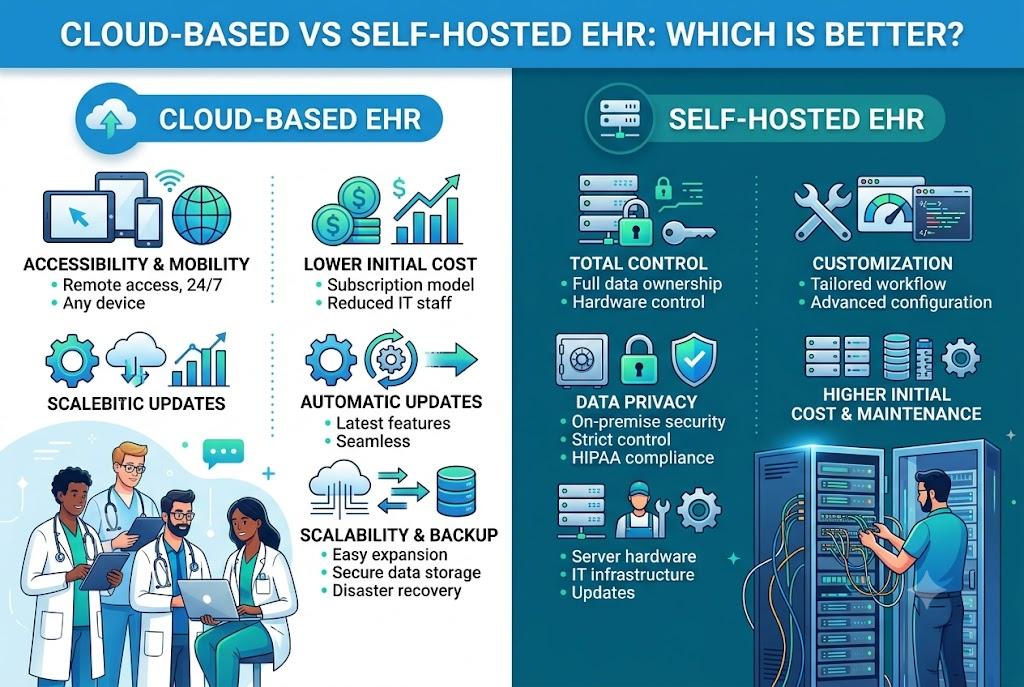
Both options have their advantages and challenges. The right choice depends on your organization's size, technical resources, budget, security requirements, and long-term goals.
What Is a Cloud-Based EHR?
A cloud-based EHR is hosted on remote servers managed by a technology provider. Healthcare organizations access the system through the internet instead of maintaining the software and servers themselves.
This approach can make getting started easier. The provider generally takes care of server maintenance, software updates, backups, and much of the underlying infrastructure.
For smaller clinics and organizations with limited IT resources, this can be an attractive option. Staff can focus more on patient care and less on managing technical infrastructure.
Cloud-based systems can also make it easier for authorized users to access information from different locations, which can be useful for organizations with multiple clinics or remote teams.
What Is a Self-Hosted EHR?
A self-hosted EHR is installed and operated on infrastructure controlled by the healthcare organization or its chosen hosting environment.
Instead of depending entirely on the EHR vendor for hosting, the organization has greater control over where its data and software are stored.
This can be especially useful for organizations that have their own IT team or specific requirements around infrastructure, data management, customization, and system access.
However, greater control also means greater responsibility. The organization may need to manage updates, backups, security, server performance, and other technical requirements.
Key Differences: Cost, Data Control, and Maintenance
The biggest difference comes down to control and responsibility.
With a cloud-based EHR, the hosting provider manages much of the technical infrastructure. With a self-hosted system, the organization has more control but also takes on more responsibility for managing the environment.
Cost
Cloud-based EHRs often use subscription-based pricing. This can make initial costs more predictable because organizations do not necessarily need to purchase and maintain their own server infrastructure.
Self-hosted systems can require more upfront investment, particularly when an organization needs dedicated infrastructure and technical staff. However, depending on the software and hosting setup, they can provide more flexibility over long-term costs.
It is necessary to look beyond the initial price. Infrastructure, maintenance, support, upgrades, security, and staff time can all affect the total cost of ownership.
If you're evaluating whether upgrading your EHR could reduce operational expenses, this guide may also help: How Upgrading to Ciyex EHR Saves Your Practice Money.
Data Control
With a cloud-based EHR, healthcare data is stored in infrastructure managed by the hosting provider. Organizations should carefully review the provider's security practices, data policies, compliance responsibilities, and backup processes.
A self-hosted EHR gives organizations more direct control over their infrastructure and data environment. This can be valuable for organizations that have specific requirements for data storage and access.
However, control does not automatically mean better security. A self-hosted environment still needs strong security controls, regular updates, backups, monitoring, and access management.
Maintenance and Updates
Cloud-based systems generally require less infrastructure management from the healthcare organization. Updates and maintenance are typically handled by the provider.
With a self-hosted EHR, the organization is more involved in maintaining the environment. This can provide greater control over when and how updates are implemented, but it also requires technical expertise.
For organizations with a capable IT team, this control can be an advantage. For smaller practices, it may create additional work.
Customization
Customization is another area where self-hosted solutions can be attractive. Organizations may have more flexibility to configure or modify a self-hosted EHR according to their specific workflows, depending on the software's licensing and architecture.
Cloud-based systems can also offer customization, but the available options may depend on the vendor and subscription plan.
Which Option Is More Secure?
Security should not be judged simply by whether an EHR is cloud-based or self-hosted.
A well-managed cloud environment can have strong security controls, while a poorly maintained self-hosted system can create significant risks.
Healthcare organizations should consider factors such as encryption, authentication, access controls, audit logs, backups, monitoring, vulnerability management, and compliance requirements.
The key question is not simply, "Where is the EHR hosted?" Instead, ask, "How is the system protected, maintained, monitored, and managed?"
Which Is Easier to Scale?
Cloud-based EHRs can make scaling easier because organizations can often expand their usage without building additional physical infrastructure. For example, a growing healthcare organization may add users, locations, or services without having to purchase and configure new servers.
Self-hosted EHRs can also scale, but the organization may need to plan for additional computing resources, storage, networking, and technical support.
For organizations with strong IT capabilities, this may not be a major challenge. For smaller practices, cloud hosting may be simpler.
What About Performance and Reliability?
Performance depends on more than hosting type.
Cloud-based EHR performance can depend on internet connectivity, the provider's infrastructure, and system configuration. A reliable provider with a well-designed infrastructure can offer consistent access to the system.
Self-hosted systems provide greater control over infrastructure and configuration, but the organization becomes responsible for maintaining system availability and handling technical issues.
Reliable backups and disaster recovery planning are important in both models.
Which Is Better for Small Clinics?
For a small clinic without a dedicated IT team, a cloud-based EHR may be easier to manage. The organization can use the software without taking on the full responsibility of maintaining servers and infrastructure.
However, an open-source EHR platform with flexible hosting options can also be useful. A clinic could choose cloud hosting while still benefiting from the flexibility of open-source software.
The best choice depends on the clinic's technical capabilities and how much control it wants over its healthcare technology.
Which Is Better for Larger Healthcare Organizations?
Larger organizations often have more complex requirements. They may need greater control over infrastructure, integrations, data management, customization, and security policies.
For these organizations, self-hosting can provide greater control when they have the technical resources to manage it effectively.
At the same time, cloud infrastructure can provide scalability and reduce the need to manage physical infrastructure internally.
There is no universal answer. The right approach depends on the organization's resources and priorities.
Cloud or Self-Hosted: You Don't Always Have to Choose One
The decision does not always have to be completely black and white.
Modern healthcare technology can support different deployment approaches. An organization may choose cloud hosting because it wants simpler infrastructure management, while another may prefer self-hosting because it needs greater control.
An open-source EHR can provide additional flexibility by allowing organizations to choose how and where the software is deployed.
How to Choose the Right EHR Hosting Model
Before making a decision, healthcare organizations should consider their current needs and future plans. Ask questions such as:
- How much control do we need over our infrastructure?
- Do we have an IT team capable of managing a self-hosted environment?
- What are our security and compliance requirements?
- How quickly do we expect to grow?
- How much customization do we need?
- What will the total cost be over several years?
- How important is flexibility in choosing our hosting environment?
- How will the system integrate with other healthcare applications?
Looking at these factors together will give you a better answer than simply comparing monthly subscription prices.
Conclusion
A cloud-based EHR can be a practical choice for organizations that want easier infrastructure management, predictable access, and simpler scaling. A self-hosted EHR can be a better fit for organizations that want greater control over their infrastructure, data environment, and customization.
Flexible solutions, including open-source EHR platforms, can give healthcare organizations more choices in how they manage and deploy their technology. Ciyex Workspace takes this approach by combining an open-source model with interoperability and FHIR R4 support, giving healthcare providers greater flexibility as their needs change.
Ready to improve your documentation workflows with a more connected approach to healthcare technology? Schedule an appointment with our team to explore how an interoperable, flexible EHR platform can support your future needs.