AI Medical Scribes vs Traditional Documentation: What's Better for Healthcare?

Doctors spend a lot of time documenting patient visits. While documentation is an important part of healthcare, it can also take attention away from the patient.
Traditional documentation often requires physicians to type notes during or after an appointment. This can make visits feel less personal and may add hours of administrative work to a provider's day.
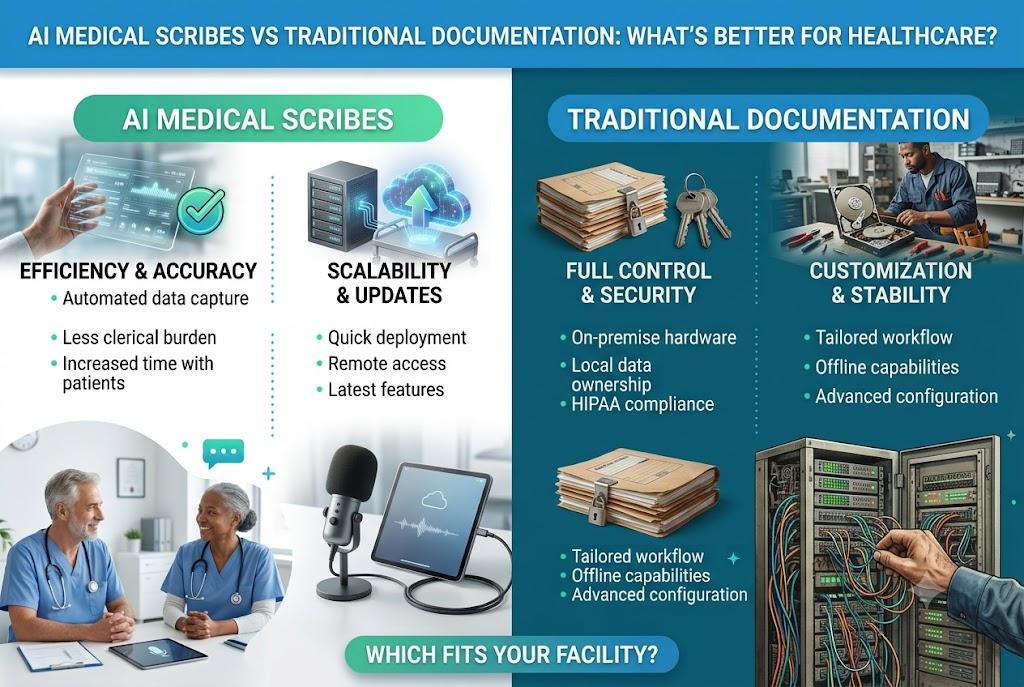
Now, AI medical scribes are changing how clinical documentation works. By using artificial intelligence to listen to conversations and help create clinical notes, these tools can reduce some of the manual work involved in documentation.
But does AI really make documentation better than the traditional approach? Let's look at the differences.
What Is Traditional Medical Documentation?
Traditional documentation usually involves a healthcare provider manually recording information from a patient visit.
A physician may type notes directly into an EHR while speaking with the patient. In other cases, they may write notes by hand or complete the documentation after the appointment.
The process is familiar, but it can be time-consuming.
Doctors need to capture important information such as symptoms, medical history, examination findings, diagnosis, treatment plans, and follow-up instructions. When several patients are seen in a day, completing all these notes can become a significant workload.
What Are AI Medical Scribes?
AI medical scribes use artificial intelligence to assist with clinical documentation.
Depending on the solution, an AI scribe can listen to a patient-provider conversation, identify relevant information, and generate a draft clinical note.
The physician can then review the note, make corrections, and approve it before it becomes part of the patient's medical record.
The technology is designed to reduce repetitive documentation work and give providers more time to focus on patient care.
AI Medical Scribes vs Traditional Documentation
The main difference is how much of the documentation process is handled manually.
With traditional documentation, the physician is responsible for creating most of the note. With an AI medical scribe, artificial intelligence can help create the first draft based on the conversation.
This can change the workflow significantly.
Time and Efficiency
Traditional documentation can continue long after the patient leaves the examination room. Providers may need to spend additional time completing notes at the end of the day.
AI-assisted documentation can reduce some of this workload by creating a draft automatically. Instead of starting every note from an empty screen, the provider can review and edit an existing draft.
This can make documentation faster and help reduce the amount of administrative work physicians take home.
More Focus on the Patient
One of the biggest benefits of AI-assisted documentation is that it can help providers spend more time engaging with patients.
When doctors are busy typing throughout an appointment, it can be harder to maintain eye contact and have a natural conversation.
Keeping Patients Part of the Conversation
Reducing documentation time is important, but the goal should not be to remove patients from the documentation process. Healthcare technology should help providers stay connected with the people they are treating.
AI-assisted documentation can give physicians more freedom to focus on the conversation, while a transparent EHR approach can help patients understand what is being recorded and why. Sharing relevant information with patients, reviewing notes together, and using the EHR as a shared resource can build trust and encourage patients to take a more active role in their care.
For more on this approach, read Enhancing the Patient-Provider Relationship Through Transparent EHR Use.
Technology should support the conversation — not become a distraction from it.
Accuracy Still Matters
Speed is useful, but accuracy is even more important when dealing with medical records.
AI-generated notes are not automatically perfect. An AI system may misunderstand a word, miss important context, or include information that needs correction.
That is why physician review remains essential. The provider should carefully check the generated note and make any necessary changes before it is added to the patient's record.
AI should assist with documentation, while the healthcare professional remains responsible for the clinical information.
Privacy and Security
Patient conversations contain sensitive health information. Any technology used to support documentation must therefore be designed with privacy and security in mind.
Healthcare organizations should carefully evaluate how an AI scribe handles patient information, where data is processed, how long it is stored, and what security measures are in place.
Organizations should also consider applicable healthcare privacy and compliance requirements before introducing AI documentation tools into clinical workflows.
Integration With EHR Systems
Another important factor is how well an AI medical scribe works with the organization's existing EHR.
If providers have to copy and paste information between different systems, some of the benefits of automation can be lost.
A better workflow allows documentation to move smoothly from the AI tool into the EHR after appropriate review. Interoperability therefore plays an important role in making AI-powered documentation practical for healthcare providers.
Traditional Documentation Still Has a Place
AI does not mean traditional documentation will disappear completely.
Some visits may require detailed manual input. Providers may also prefer to write certain parts of a note themselves.
Different specialties and healthcare settings have different documentation requirements.
The best approach may therefore be a combination of AI assistance and human review rather than completely replacing traditional documentation.
What Are the Benefits of AI-Assisted Documentation?
When implemented properly, AI medical scribes can help healthcare organizations improve the documentation process. They may help providers:
- Spend less time typing notes
- Reduce repetitive administrative work
- Focus more on patient conversations
- Complete documentation more efficiently
- Create structured drafts for review
- Reduce documentation workload
However, these benefits depend on the quality of the technology, the clinical workflow, and how effectively the tool is integrated into the EHR.
AI and the Future of EHR Documentation
Healthcare documentation is moving toward a more automated and connected future.
AI can handle some repetitive tasks while healthcare professionals continue to make the important clinical decisions. This creates an opportunity to build workflows where technology supports providers instead of adding more administrative work.
The future of documentation is unlikely to be about choosing between humans and AI. Instead, it will be about finding the right balance between automation and human expertise.
Conclusion
AI medical scribes can make clinical documentation faster and less demanding, but technology should always support healthcare professionals rather than replace their judgment. Traditional documentation still has an important role, while AI can help reduce repetitive work and give providers more time to focus on their patients.
As healthcare moves toward more connected and intelligent workflows, having a flexible EHR platform becomes equally important. Ciyex Workspace is an open-source EHR platform designed to support modern healthcare needs, including interoperability and FHIR R4. By providing a flexible foundation for connecting healthcare applications and workflows, Ciyex can help organizations adopt new technologies while keeping patient information organized and connected.
Ready to modernize your EHR and improve clinical workflows? Schedule an appointment with our team to learn how a flexible, interoperable EHR platform can support your goals.